Neon Element Facts: What Makes This Noble Gas So Unique?
Neon is an element most people know by sight before they know the name. We see the iconic glow, but the element neon (Ne) is part of the noble gas family. In this guide, we cover neon element facts to explain how a rare, invisible gas became a recognizable element.


Key Takeaways
- Neon is a noble gas with the symbol Ne and atomic number 10. It is stable, colorless, odorless, and chemically quiet.
- Neon is famous for its red-orange glow, but it also matters in lasers, scientific tools, cryogenics, and electronics.
- Neon is rare in Earth’s atmosphere, which helps explain why pure neon can be costly and supply chains can become strained.
- We supply high-quality custom LED neon signs that mimic the appearance of traditional glass ones but with superior durability, versatility, and energy efficiency.
Table of contents
-
Neon Element Facts
-
What Makes Neon Different From Other Elements And Noble Gases?
-
What Are The Most Interesting Facts About Neon?
-
What Is Neon Most Known For?
-
How Does Neon Glow And Power Neon Signs?
-
How Was Neon Discovered And Why Did It Change Chemistry Forever?
-
Why Is Neon So Rare On Earth?
-
Is Neon Dangerous To Humans?
-
Why Is Neon Expensive?
Neon Element Facts
Neon element facts start with the basics. Neon is a noble gas in Group 18 of the periodic table, with the atomic symbol Ne and atomic number 10. At room temperature, it is a gas that has no color or smell.
Neon doesn’t react easily with other elements. That stability is one reason scientists found it so fascinating. Neon became famous because it glows a clear red-orange when electricity passes through it.
That contrast is interesting: invisible in a normal room, but unforgettable in a glass tube. It is both a chemistry lesson and a design icon.
Here is a quick neon facts table:
| Fact | Answer |
|---|---|
| Element name | Neon |
| Symbol | Ne |
| Atomic number | 10 |
| Element family | Noble gas, Group 18 |
| State at room temperature | Gas |
| Natural appearance | Colorless and odorless |
| Famous glow | Red-orange in gas-discharge tubes |
| Discovered | 1898 |
| Discoverers | William Ramsay and Morris Travers |
| Common uses | Signs, indicators, lasers, scientific instruments, cryogenics |
What Makes Neon Different From Other Elements And Noble Gases?
Neon belongs to the noble gas family because its outer electron shell is full. That makes it very stable. Unlike reactive elements such as sodium or chlorine, neon does not rush to bond with other atoms.
It usually stays alone as single atoms in a gas. Compared with heavier noble gases, neon is lighter and more difficult to trap on Earth in large amounts. It is chemically unique because it behaves almost like it wants no drama at all.
We can use it in lighting, like in custom glass neon signs, and in scientific work. This is because it responds to electricity with light, not because it reacts like an ordinary chemical.

Why Is Neon Special?
Neon is special because it is calm chemically but dramatic visually - that is a rare pairing. It does not burn, corrode, or form common compounds, yet it can produce one of the most famous glows in lighting.
Neon also matters in science and industry. It is used in:
- Signs
- High-voltage indicators
- Helium-neon lasers
- Certain cryogenic applications.
Its extreme stability is a distinctive property and makes it useful where predictable behavior matters.
Of course, most people still think of signs first. This isn’t surprising - a bright red-orange tube in a dark street is easier to remember than a periodic table box. That cultural power keeps neon relevant.
Looking to make your own neon sign?
Choose us as expert custom neon sign makers with a long history in the industry and the tools and skills to craft high-quality LED neon lights.
What Are The Most Interesting Facts About Neon?
One interesting fact about neon is that it was discovered in 1898 by Sir William Ramsay and Morris Travers while they were studying rare gases in air. Another is that the name comes from the Greek word “neos”, meaning new.
Here are some other facts:
- Neon is much more common in the universe than on Earth, which feels slightly unfair when you see its price.
- It is also responsible for the classic red-orange glow in true neon signs - there are some famous neon signs that people recognize all over the world.
- Other colors often come from different gases, coatings, or modern LED systems.
We find that final detail useful because people often call every bright sign “neon,” even when no neon gas is inside.
What Is Neon Most Known For?
Neon is most known for illuminated signs. Its red-orange glow became tied to nightlife, theaters, motels, restaurants, shop windows, and city streets. The look is bold without needing much explanation.
A neon sign can be read from far away, especially after dark, which made it useful for advertising. Over time, it also became part of art and interior design. People associate neon with energy, memory, and a certain kind of urban romance.
Today, many signs use LED neon instead of glass neon, but the visual language comes from the original gas. Those iconic gas-discharge lamps have a permanent place in visual culture, even if they have been largely replaced by LED ones now.
What Are The Most Common Uses Of Neon Beyond Neon Signs?
Neon has uses beyond advertising signs. It appears in high-voltage indicators, some lasers, vacuum tubes, lightning arresters, and scientific instruments. Let’s look at some of these in more detail:
- Helium-neon lasers were once common in labs, teaching, barcode scanning, and alignment work.
- Neon is also used in some cryogenic applications because liquid neon has strong cooling ability, though it is expensive.
- In electronics manufacturing, neon can be part of gas mixtures used with lasers for chip production.
The sign industry made neon famous, but science kept it useful as an iconic alternative to custom vacuum forming signs and other varieties. We sometimes forget that an element can be both decorative and technical - neon manages both roles quite well.
Create neon signs that reflect your passions
With our service, you can create custom Minecraft neon lights or choose other interests and create something that reflects your personality.
Learn moreHow Does Neon Glow And Power Neon Signs?
Neon glows when electricity passes through low-pressure neon gas inside a sealed tube. The electrical energy excites the neon atoms. When those atoms settle back down, they release light.
For neon, that light is the famous red-orange color. Traditional neon signs are made by:
- Bending glass tubes into shapes
- Sealing them
- Removing air
- Adding gas
- Connecting electrical parts
It takes skill to make them. The glow is not paint or a bulb shining through colored glass, it comes from energized gas. That is why real neon has such a distinct look. Modern custom LED neon signs mimic the effect in a safer, lighter way.

Why Are Neon Signs Handmade And Considered An Art Form?
Traditional neon signs are considered an art form because they need hand skill at almost every stage. A glass bender heats tubing over a flame and shapes it carefully before it cools. Curves, letters, corners, and joins all need control.
From here, the tube must be:
- Sealed
- Filled
- Tested
- Mounted
One rushed bend can crack the glass or ruin the lettering. This is a key difference in LED neon vs glass neon lights, as LED tubing is much more forgiving.
This artistry is why old neon signs are collectible. They are part science, part craft, part street culture. Even when LED neon is the better practical choice for many homes and events, real neon carries a handmade character.
Need a custom-sized neon sign for your space?
Work with us to create custom 20-inch neon signs or choose from a range of other sizes, colors, fonts, and more to get the look you want.
How Was Neon Discovered And Why Did It Change Chemistry Forever?
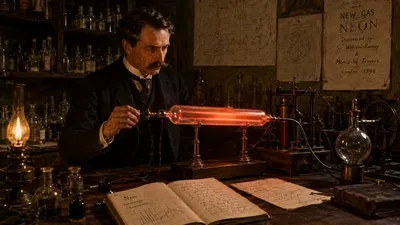
Neon was discovered in 1898 by Sir William Ramsay and Morris Travers in London. They were separating gases from liquid air when they found a new gas with a bright red spectral glow. This mattered because it helped confirm the noble gas group.
Chemists had to make room for elements that did not react in the usual way. That changed how the periodic table was understood. Ramsay’s work on inert gases later earned him the 1904 Nobel Prize in Chemistry.
Neon was not just a neat lab find; it helped prove that air still held secrets scientists had missed. Work with us to create custom aesthetic neon signs crafted from LED tubing that is inspired by the work on discovering and harnessing neon gas.
What Does The Name ‘Neon’ Mean And Why Was It Chosen?
The name ‘neon’ comes from the Greek word “neos,” meaning new. It suited the element because Ramsay and Travers had found another unknown gas in air. The story often says Ramsay’s son suggested the name, which gives the discovery a nice human detail.
Scientists have long used Greek and Latin roots when naming elements because those languages gave names a formal, shared base across countries. Around the same time, the noble gases krypton and xenon were named as well.
Neon was part of a burst of noble gas discoveries, so “new” was not a lazy choice. It marked a moment when chemistry was still opening drawers nobody knew were there.
Why Is Neon So Rare On Earth?
Neon is rare on Earth because it is light, inert, and hard for the planet to hold onto in large amounts. The Royal Society of Chemistry lists neon at about 18 parts per million in Earth’s atmosphere - that is not much.
It is more abundant in the universe, but Earth did not keep a large supply. Since neon does not react easily, it does not get locked into rocks and minerals the way some elements do. To obtain usable neon, producers usually separate it from air through large industrial air-separation systems.
That takes equipment, energy, and careful purification. But it leads to the creation of those iconic neon signs that reflect in your custom two-tone tropic sunglasses.
What Is The Cosmic Connection Between Neon And Stars?
Neon has a life beyond signs and labs. It forms in stars through nuclear processes, especially in the intense conditions inside massive stars. Astronomers can also detect neon emissions in space, including in nebulae and hot gas clouds.
Those light signatures help scientists understand what distant objects are made of. This is one of the more beautiful neon element facts, in our view. The same kind of element that lights a sign can also help explain the chemistry of the universe.
The abundance of neon in the universe is connected to stellar and solar chemistry. Neon reminds us that the periodic table is not only classroom material - it is also a map of stars.
Add your quote to a custom LED neon sign
We specialize in bringing custom neon light quotes to life so you can have a word or message as the glowing focal point in any space.
Get startedIs Neon Dangerous To Humans?
Neon is generally considered non-toxic, but that does not mean it has no risks. The main danger is displacement of oxygen. In a confined space, a large leak of any inert gas can reduce breathable air and create an asphyxiation hazard.
Compressed gas cylinders also need proper handling because pressure can be dangerous. Liquid neon is extremely cold and can cause frostbite if handled badly. Though neon signs are not dangerous generally, the neon that goes into them can be.
For normal signs, the bigger safety issues are:
- Electrical parts
- Glass breakage
- Installation quality
Used properly, neon is not something to fear. Used carelessly, even a stable gas can become a workplace hazard.
What Are The Hidden Dangers Of Neon?
The hidden dangers of neon are usually about storage and equipment, not chemical poisoning. For example, compressed cylinders can become dangerous if damaged, heated, or handled roughly.
Here are some potential risks of neon in different applications:
- Cryogenic neon can freeze skin on contact.
- Traditional neon signs also involve glass tubes that can break and electrical systems that must be installed correctly.
- In shipping, gas containers need proper labels, caps, and secure positioning.
- In workshops, ventilation matters because inert gases can quietly push oxygen out of a small space.
These risks are manageable, but they are real. That is why industrial safety standards exist and why damaged signs should not be repaired casually.
Why Is Neon Expensive?
Neon is expensive because it is rare in the atmosphere and difficult to produce in usable purity. It is usually recovered through large air-separation operations, then purified for specific uses.
Demand can affect price, and it comes from different applications like:
- Lighting
- Lasers
- Scientific work
- Semiconductor production
Supply is also concentrated in certain industrial regions, which makes the market sensitive to disruption.
When supply tightens, prices can rise quickly. For signs, this is one reason many people now choose custom LED neon signs instead of traditional glass neon. LED options do not need neon gas, so they are a popular choice for custom neon signs for retail stores and homes.

What Caused The Global Neon Shortage?
The global neon shortage was tied to semiconductor demand and supply disruption. Neon is used in gas mixtures for lasers involved in chipmaking. Semiconductor production depends largely on neon supplied by Ukraine.
Before and during the Russia-Ukraine war, the semiconductor-grade neon supply chain was highly linked to Russia and Ukraine. CSIS reported in 2024 that Russia’s full-scale invasion in February 2022 cut off as much as 40 to 50 percent of global supply.
That affected electronics manufacturing because chip production depends on stable material supply. The issue showed how one rare gas can matter far beyond signs, labs, or chemistry classrooms. Supply chains can be surprisingly delicate.
Frequently Asked Questions About 'Neon Element Facts'
What Are The Most Interesting Facts About The Neon Element?
Neon is element Ne, atomic number 10, and a noble gas. It is rare on Earth, glows red-orange under electricity, and was discovered in 1898 by Ramsay and Travers.
Why Is Neon Unique Compared To Other Noble Gases And Elements?
Neon is extremely stable, light, and visually famous for its red-orange glow. Compared with reactive elements, it barely forms compounds and usually stays as single atoms.