Who Discovered Neon And How Was It Found?
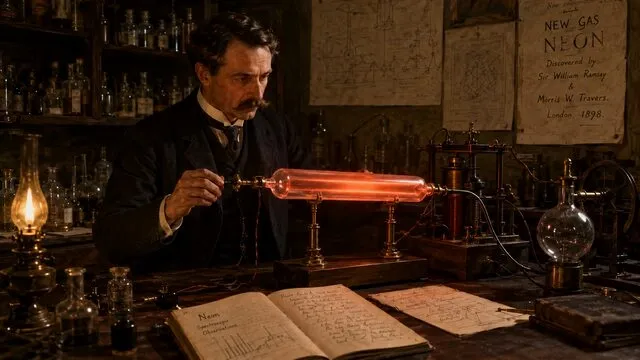
Neon feels modern because of glowing signs, city streets, and bars, but scientists discovered neon in a chemistry lab in 1898. In this guide, we look at how Sir William Ramsay and Morris Travers gave science a clearer view of the periodic table through their work on noble gases.

Key Takeaways
- Neon was discovered in 1898 by Sir William Ramsay and Morris Travers during research into rare gases found in air.
- The discovery helped scientists understand noble gases, a group of elements known for very low chemical reactivity.
- Neon’s red-orange glow made it famous later through signs, advertising, lighting, and today’s custom LED neon sign designs.
- We supply high-quality custom LED signs that you can personalize to get the shape, size, fonts, and colors you want for your space.
Table of contents
-
Who Discovered Neon?
-
What Is The Story Behind Neon’s Discovery?
-
How Was Fractional Distillation Used To Discover Neon?
-
Why Did Neon Glow Red-Orange During Testing?
-
Why Was Neon Named Neon And What Does The Name Mean?
-
How Did Neon’s Discovery Change Chemistry And The Periodic Table?
-
What Is The Connection Between Neon, Krypton, And Xenon?
-
How Did Scientists Know Neon Was Different From Other Gases?
-
How Did Neon Become Famous Through Signs Lighting And Advertising?
-
How Did The Discovery Of Neon Affect Physics Research?
Who Discovered Neon?
Sir William Ramsay and Morris Travers discovered neon in 1898 in London. Ramsay was already deeply involved in the study of inert gases, while Travers worked with him on the careful lab experiments needed to separate rare gases from air.
Their discovery was important because it helped prove that the atmosphere contained more than oxygen, nitrogen, argon, and carbon dioxide. It also showed that the periodic table still had missing pieces.
Neon would later become famous for its red-orange glow when electricity passes through it. That helped the element move from a purely scientific discovery to a feature in everyday culture, especially through signs and display lighting.
What Is The Story Behind Neon’s Discovery?
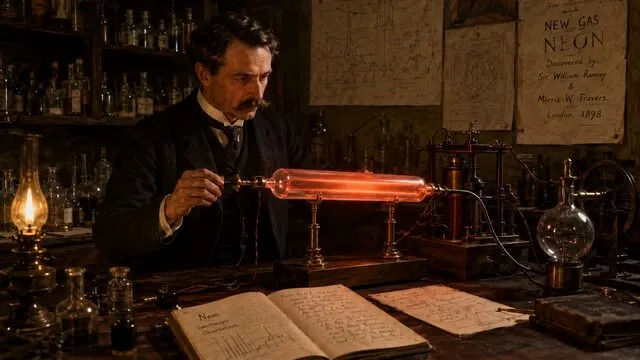
Before neon was found, Ramsay and Travers were trying to understand the gases hiding in Earth’s atmosphere. Argon and helium had already raised big questions - if those gases existed, could others be present too?
The pair used improved laboratory tools to cool, liquefy, and separate air into parts. This was slow work. The gases were rare, and the samples were tiny. Still, the search was worth it.
Neon joined a growing list of inert gases that did not react easily with other elements. We now call them noble gases, but at the time, they were strange new pieces of chemistry. They would later go on to become the key component of custom glass neon signs.
| Gas | Discovery connection | Glow or color association | Common uses |
|---|---|---|---|
| Argon | Discovered before neon and helped lead scientists toward the search for other inert gases in air. | Often produces a pale lavender or bluish glow in discharge tubes, depending on conditions. | Light bulbs, welding, windows, some lighting applications. |
| Neon | Discovered by Sir William Ramsay and Morris Travers in 1898 while studying rare gases from liquid air. | Produces a bright red-orange glow when electricity passes through it. | Neon signs, indicator lights, high-voltage signs, decorative lighting, scientific instruments. |
| Krypton | Also isolated by Ramsay and Travers during their rare gas experiments in 1898. | Can produce a whitish or pale glow, depending on the tube and electrical conditions. | Specialist lighting, photography flashes, lasers, some high-performance windows. |
| Xenon | Found by Ramsay and Travers in the same wider period of noble gas research. | Produces a bright white or bluish-white light in certain lamps. | Car headlights, flash lamps, projectors, medical lighting, scientific equipment. |
Interested in the modern version of traditional neon signs?
Work with us to create custom LED signs that replicate the look of traditional neon with superior versatility and durability.
How Was Fractional Distillation Used To Discover Neon?
Fractional distillation is a way to separate substances by their boiling points. This is how noble gases are obtained - in simple terms, Ramsay and Travers cooled air until it became liquid, then warmed it slowly.
As the liquid air heated, different gases boiled off at different temperatures. Those gases could then be collected and tested. This method was useful because neon exists in very small amounts in the atmosphere - ordinary testing would not easily reveal it.
During the same period of research, fractional distillation helped scientists isolate:
- Neon
- Krypton
- Argon
- Xenon
It sounds neat when you write it down, but in practice it required careful control, patience, and very good lab technique.
Why Was Isolating Neon Difficult During Early Gas Experiments?
Isolating neon was difficult because there is not much of it in air. The Royal Society of Chemistry lists neon in Earth’s atmosphere at about 18 parts per million, which means scientists had to work with tiny amounts.
Temperature control was another challenge. Liquid air had to be warmed in a controlled way, and each gas fraction had to be handled without contamination. This experimentation took time, so it was a while before neon lights were invented.
Early equipment was far less convenient than modern lab systems. We sometimes forget how physical chemistry was then - success came down to things like:
- Tubes
- Pumps
- Cold liquids
- Careful manual observation
- Repeated testing
One rushed step could mix gases and spoil the result.
Why Did Neon Glow Red-Orange During Testing?
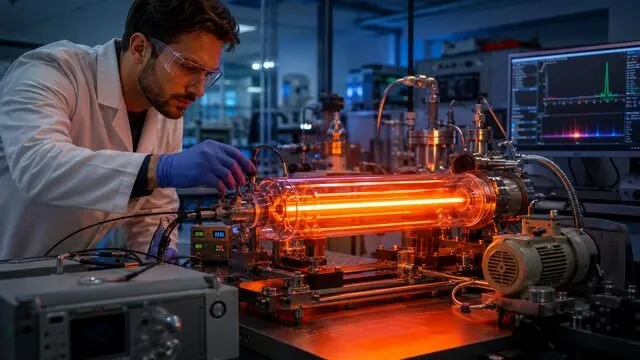
Neon glows red-orange when it is placed in a tube and exposed to an electric charge. The energy excites the neon atoms, and when they release that energy, they give off light at specific colors.
This made neon stand out. It was not just another invisible gas in a glass tube; its bright glow helped scientists recognize that they were dealing with something distinct. That same property later made neon ideal for illuminated signs.
The color was bold, easy to see, and hard to ignore. In a funny way, the lab test foreshadowed the shopfront signs people would come to associate with nightlife and advertising. Electrical excitation produces visibility luminosity - it was only a matter of time before that was put to use.
What Is Neon’s Spectral Signature And Why Was It Important?
Each element gives off a unique set of colored lines when energized. This is called its spectrum. Neon’s spectrum showed strong red-orange lines, which helped confirm that the gas was not one already known to science.
Spectroscopy was important because gases can look identical when sitting quietly in a container. Many are colorless and odorless. But when electricity passes through them, their light patterns reveal their identity.
That was a powerful tool for chemists. For neon, the spectral signature acted almost like a fingerprint. It gave Ramsay and Travers evidence that they had found a previously unknown element, not a mixture or mistake.
Work with a modern neon sign maker and customize your piece
With our service as custom neon sign makers, you can build your neon sign design from the ground up with cutting-edge LED technology.
Learn moreWhy Was Neon Named Neon And What Does The Name Mean?
The name neon comes from the Greek word “neos,” meaning “new.” It was a fitting name because the gas was one of several newly discovered inert gases changing chemistry at the time. Neon’s identity and uniqueness made that name perfect for it.
The naming story often says Ramsay’s son suggested the name after hearing about the discovery. Whether we focus on the family story or the Greek root, the meaning is clear: this was a new element, found through new techniques, at a time when the periodic table was still being refined.
Scientists often used Greek and Latin roots for element names because those languages gave names a formal, international feel.
How Did Neon’s Discovery Change Chemistry And The Periodic Table?
Neon’s discovery helped chemistry accept a fuller noble gas group. These gases were unusual because they showed very low reactivity. That challenged older ideas about how elements behaved and how the periodic table should be organized.
Ramsay’s work helped reveal a whole group of inert gases, including:
- Helium
- Neon
- Krypton
- Xenon
This gave the periodic table a more complete structure. It also showed that air was not as simple as people once thought.
In 1904, Ramsay received the Nobel Prize in Chemistry for his services in discovering inert gaseous elements in air. Neon was part of that wider scientific achievement. It soon led to the invention of neon signs.
You can work with us to create custom neon flex signs, a modern alternative to traditional neon lights. Our low-cost products replicate the iconic look of those signs but use modern LED technology for a more durable, versatile and energy-efficiency solution.
Why Did William Ramsay Receive A Nobel Prize For Noble Gas Discoveries?
William Ramsay received the 1904 Nobel Prize in Chemistry because of his work discovering inert gaseous elements in air. Neon was one part of that larger story. Ramsay did not simply find one gas and stop - he helped identify a family of gases that behaved in a way chemists had not fully understood before.
That work expanded the periodic table and changed how scientists thought about chemical reactivity. We can see why the Nobel committee noticed - his discoveries were not decorative facts. They altered the map of chemistry.
Travers also played a major role in the experimental work behind neon, krypton, and xenon. Among many other things, these would help with the invention of neon signs, a luminous alternative to custom vinyl banners that became iconic pieces of urban infrastructure.
Looking to create your own neon sign?
Our custom aesthetic neon signs are built for the modern world with superior energy efficiency, durability, and customization options.
What Is The Connection Between Neon, Krypton, And Xenon?
Neon, krypton, and xenon are all noble gases. Ramsay and Travers isolated them during their work with liquid air and fractional distillation in 1898. They share important features:
- They are colorless gases under normal conditions
- They react only with difficulty
- They produce distinctive light when energized
Since their discovery, there have been many noble gas experiments leading to countless more inventions.
Knowledge of their existence helped fill gaps in the periodic table and made the noble gas group clearer. Krypton and xenon never became as famous in shop signs as neon, but they have their own uses in lighting, photography, and science.
Together, these gases proved that the atmosphere contained rare elements hiding in plain sight.
How Did Scientists Know Neon Was Different From Other Gases?
Scientists knew neon was different by testing its behavior and light. First, they separated gas fractions from liquid air. Then they compared those samples with known atmospheric gases. Neon’s low reactivity matched the pattern of inert gases, but its glow and spectral lines made it distinct.
When electricity passed through the gas, it produced a bright red-orange light. That visual clue was backed by spectroscopy, which showed a unique pattern. Electrical testing mattered because it made invisible gases reveal themselves.
Without that step, neon could have stayed hidden among other separated gases. It is a good reminder that discovery often depends on the right test. That glow would become the driving force between neon signs - an iconic alternative to custom frontlit trimcap signs and more.
Discover the wider range of colors in modern neon signage
We offer custom auburn neon signs and various other colors made possible by modern LED technology, making traditional neon a thing of the past.
Get startedHow Did Neon Become Famous Through Signs Lighting And Advertising?
Neon became famous because it was bright, colorful, and visible at night. Once people learned to put neon gas inside shaped glass tubes and run electricity through them, the element became a sign maker’s dream.
Cities used neon lighting for things like:
- Theaters
- Hotels
- Diners
- Bars
- Storefronts
It gave businesses a way to be seen after dark and gave streets a lively, electric look. This gave rise to a number of iconic neon signs at famous locations.
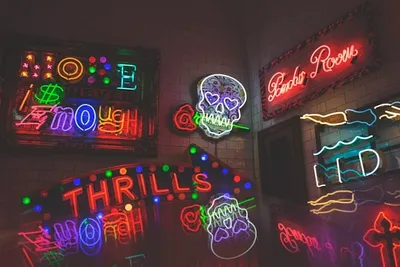
Over time, neon became more than a gas - it became a style. Even today, when many signs use LED neon instead of real neon gas, people still use the word “neon” to describe that glowing visual mood.
Why Did Businesses Prefer Neon Lighting?
Businesses preferred neon lighting because it was hard to miss. A glowing sign could pull attention from down the street, especially at night or in busy city areas. Neon signs were also durable when made and maintained well.
Their shapes could be customized for names, logos, arrows, and slogans. That mattered for restaurants, theaters, motels, and bars competing for attention. The red-orange glow of neon was especially striking, though other gases and coatings later expanded sign colors.
You can still see the same idea today with our custom LED neon signs. The technology changed, but the goal stayed simple: be seen fast. This is apparent in bar lighting ideas for interiors as well as exterior signage.
How Did The Discovery Of Neon Affect Physics Research?
Neon helped physics because glowing gases gave scientists a way to study atoms, electricity, and energy. When neon atoms are energized, they release light in specific wavelengths. That made neon useful in spectroscopy, where researchers study the light given off by elements.
This work connects to atomic theory because light patterns reveal information about electron energy levels. Early gas discharge experiments also helped scientists understand how electricity behaves in low-pressure tubes.
Neon was not only useful for signs - it was part of a wider scientific world where light, matter, and energy were becoming easier to measure. Early physics research took a leap forward as noble gases became important to spectroscopy and spectral-line measurement.

Where Is Neon Used In Modern Technology?
Neon is still used in signs, high-voltage indicators, some lasers, vacuum tubes, and scientific instruments. Helium-neon lasers were once common in labs, barcode scanners, and teaching demonstrations, though other laser types now handle many jobs.
Neon remains valuable because it produces a strong visible glow and behaves predictably under certain electrical conditions. In display culture, the word “neon” is now also tied to LED signs that mimic the old look without using neon gas. That matters for environments like:
- Homes
- Events
- Shops
- Studios
Traditional neon gave us the visual language. Modern custom LED neon signs made that look lighter, safer, and easier to install. Work with us to make your own neon sign with modern technology and enjoy that iconic glow without the complex chemical reactions.
Frequently Asked Questions About Who Discovered Neon
Who Discovered Neon In 1898?
Sir William Ramsay and Morris Travers discovered neon in 1898 in London while studying rare gases separated from liquid air. Their work helped define the noble gases.
What Historical Events LED To The Discovery Of Neon?
The discovery followed earlier noble gas research, including work on argon and helium. Ramsay and Travers then used liquid air and fractional distillation to isolate neon, krypton, and xenon.